
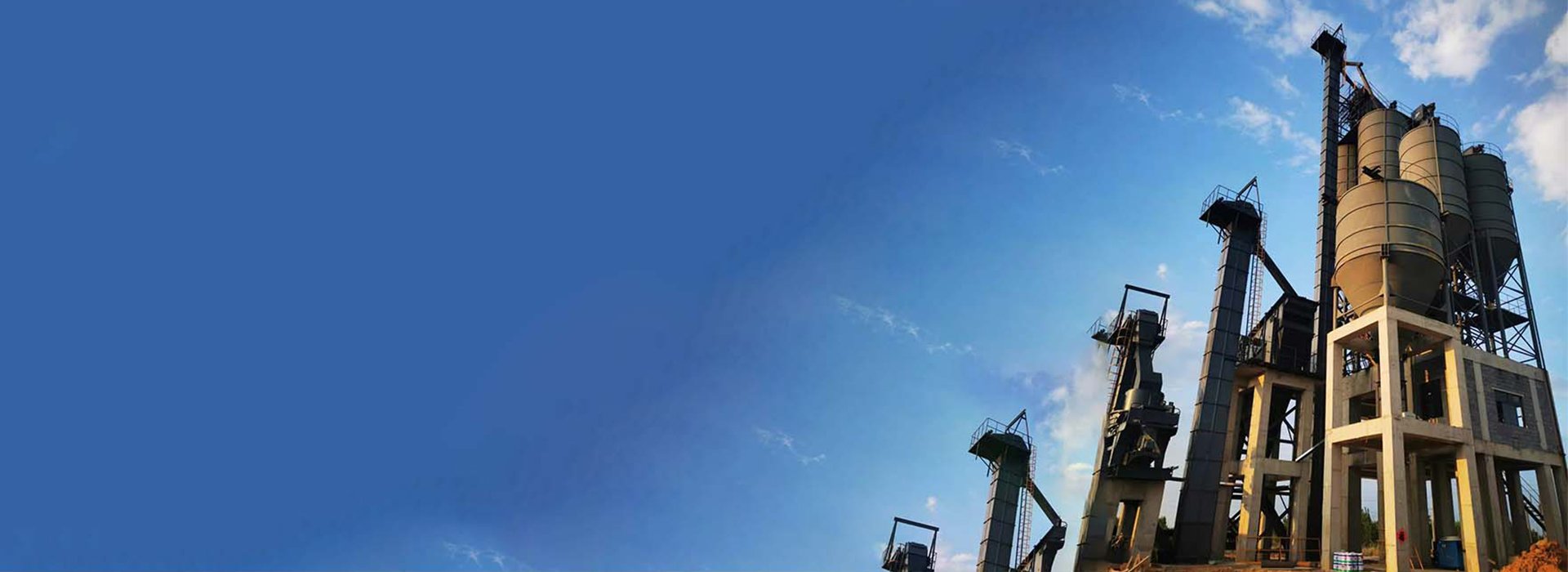
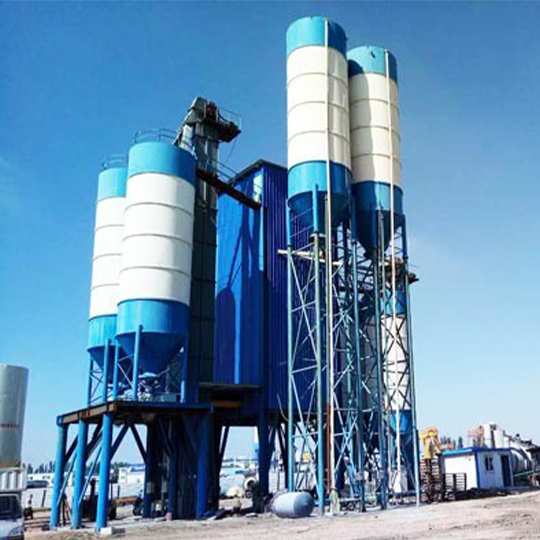
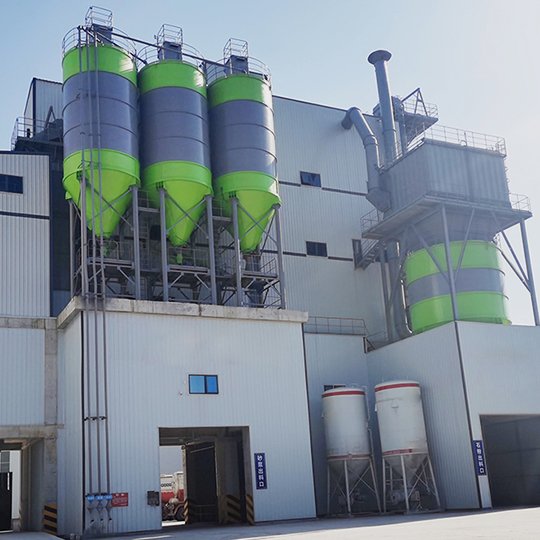
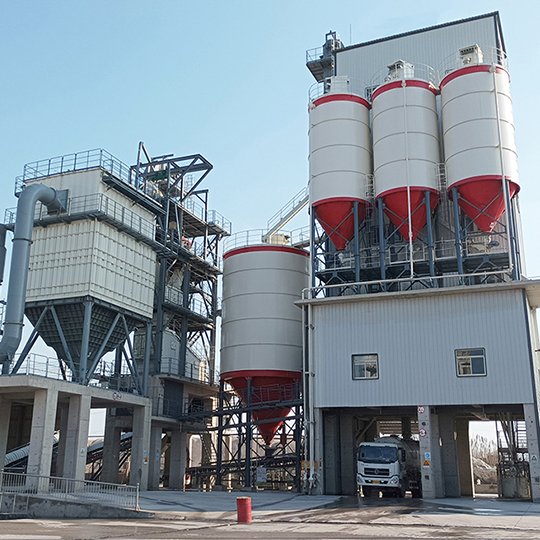
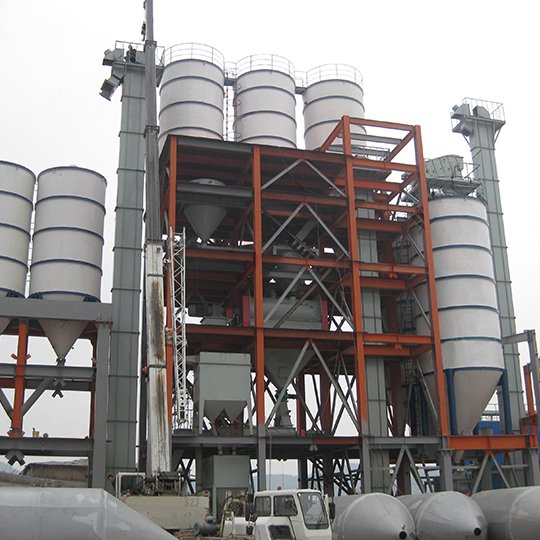
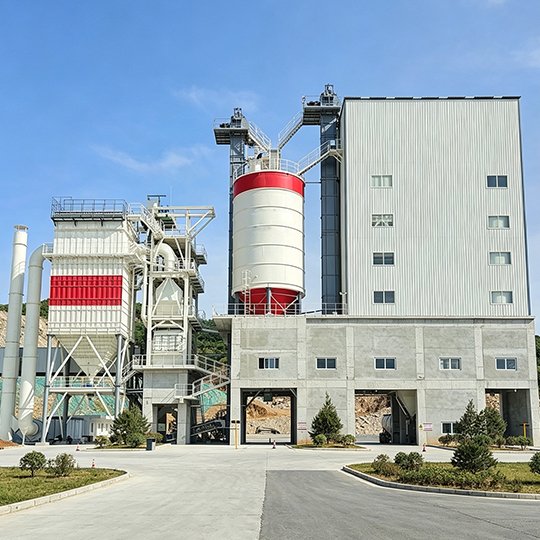
Why Choose SDCAD Dry Mix Mortar Plant
- SDCAD has years of experience in manufacturing large-scale mortar lines.
- Our dry mix mortar plants are certified to CE, ISO 9001, CIC, UL, and EPA standards.
- Our dry mix mortar plants are exported to more than 60 countries across seven continents.
- Equipped with an automated PLC system to improve production efficiency.
- We supply fully automatic 5–80t dry mix mortar plant with various configurations.
- Suitable for a variety of production lines, including dry-mix mortar, and tile adhesive.
What is Dry Mix Mortar Plant?
Dry mix mortar batching plants are widely used in the building materials, infrastructure, and industrial manufacturing sectors. These plants automatically measure, mix, and package cement, sand, fly ash, lime, mineral admixtures, and various additives to produce dry mix mortar products of consistent quality that meet the high standards of the building materials market.
We provide production lines for dry mix mortar, putty powder, tile adhesive, gypsum-based mortar, cement-based mortar, grout, UHPC, ordinary mortar, packaging, and palletizing, among others.
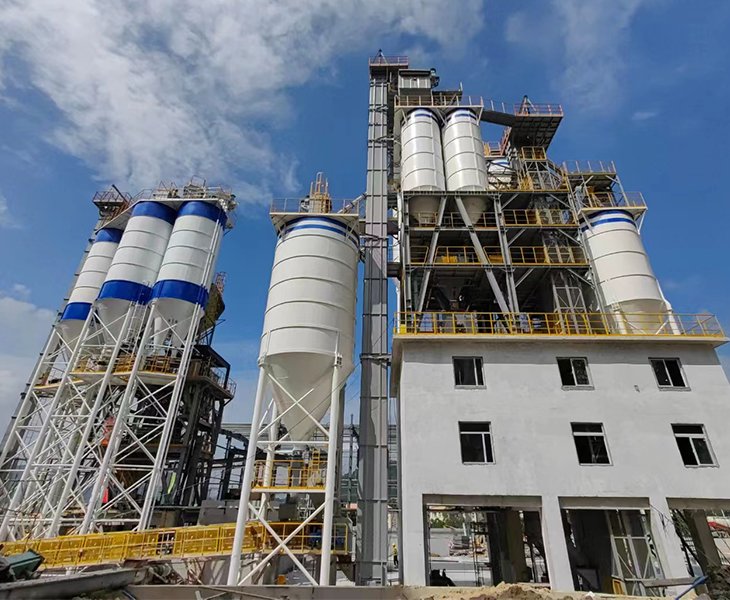
Your Professional Dry Mix Mortar Plant Supplier
SDCAD has years of experience in manufacturing dry mix mortar plants. Our innovative systems enable fully automated production operations—from raw material feeding, metering, and mixing to finished product conveying and packaging—without any manual intervention. You can preset multiple production formulas and process parameters based on your production needs and quickly recall them when switching production tasks, helping you reduce production setup time, improve equipment utilization, and ensure production continuity. Contact us today for a free, customized plant design and quote.
Why Choose SDCAD Dry Mix Mortar Plant?

System regulates material ratio, mixing time and conveyor speed to cut human error.

Single line produces multi-formula dry mortars to meet various demands.

Quick troubleshooting to minimize downtime and improve production line stability.

System data management and real time logging improve production efficiency.
Dry Mix Mortar Plant Enables Efficient Production
The SDCAD dry mix mortar plant features automatic batching and packaging, PLC-based intelligent control, and rapid material clearance. It can switch between recipes in less than one second, enabling a single production line to manufacture more than 30 different product formulations to meet diverse market demands.
In addition, our system collects real-time operational status data (such as motor speed, valve status, and material levels) and process parameters from all production line equipment and displays them dynamically on the interface. This allows operators to monitor production conditions at all times. In the event of a malfunction or abnormal parameters, the system automatically issues an alarm and displays the location and cause of the fault, enabling rapid troubleshooting, minimizing downtime, and helping you improve production efficiency.
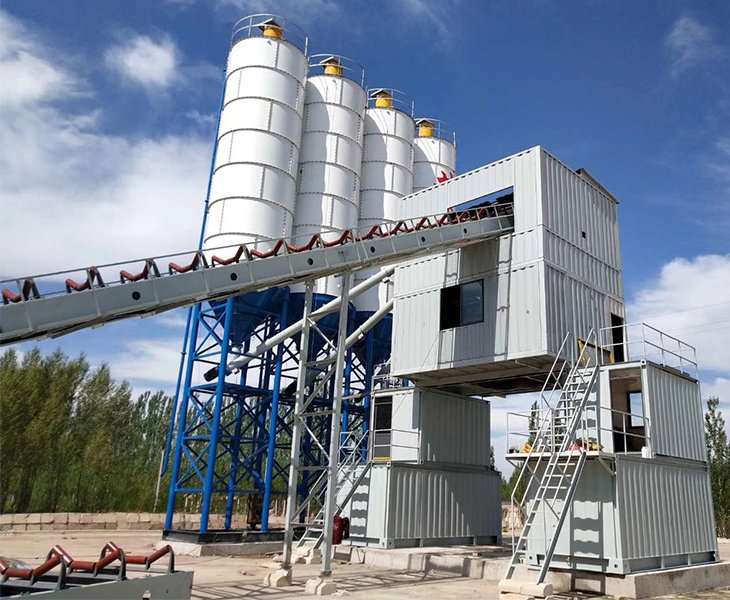
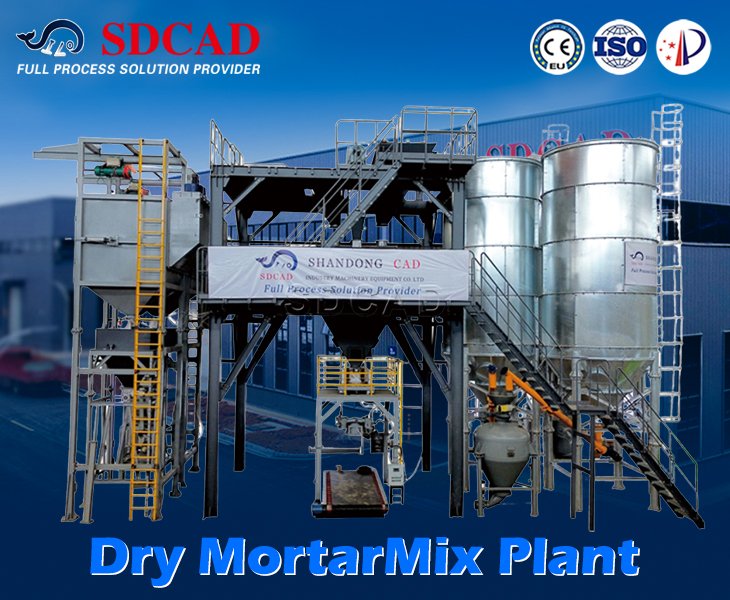
Dry Mix Mortar Plant Enables Precise Batching
By choosing an SDCAD dry mix mortar plant, you will benefit from a professional powdered additive metering system and high-precision powder weighing screw conveyors. You will no longer need to worry about inaccurate weighing of trace additives, as our equipment is equipped with highly sensitive precision sensors and proven, advanced control algorithms. These core components measure the dosage of trace additives with extreme precision and strictly limit measurement errors to an extremely small range.
To further eliminate the risk of formulation deviations that plague many manufacturers, our production line employs an independent secondary reweighing process. This dual-verification mechanism comprehensively ensures the dosing accuracy of all raw materials, ensuring that every batch of finished mortar strictly adheres to preset formulation standards. This helps you maintain consistent and reliable product quality, earning long-term trust in the market.
Why Choose SDCAD for Your Dry Mix Mortar Plant Projects?
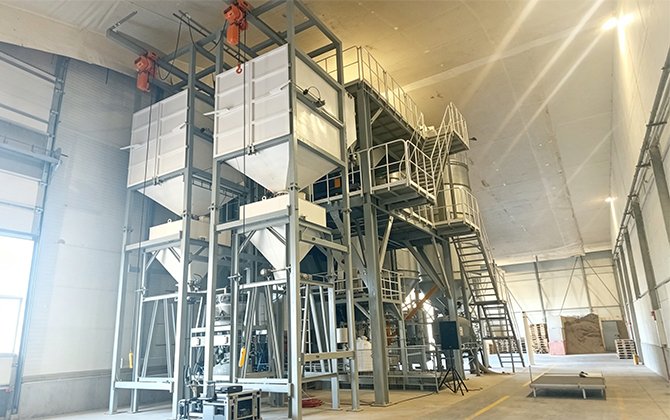
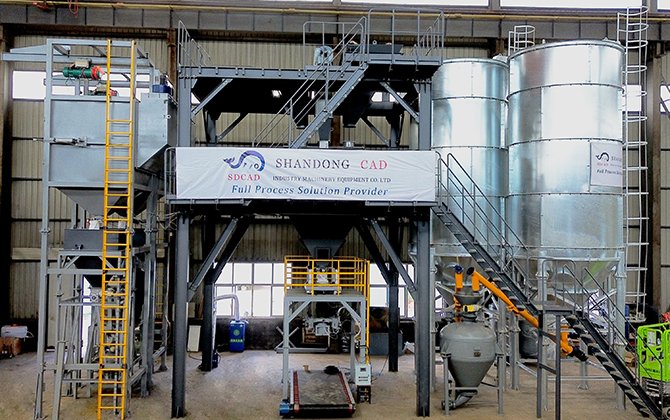
SDCAD is a direct manufacturer
The steel structure components are manufactured in-house. The mixer is a well-known domestic brand, Shuanglong; sensors are from Media; cylinders are from Yadek; the vibration motor is from Ouli Wolong; the PLC is from Siemens; and the screw conveyor is from Sicoma.
Comprehensive Pre-Sales Technical Support
In addition to designing production line solutions, planning factory layouts, and providing recommendations on production processes, we also offer on-site installation guidance from our engineers.
Highly automated control improves production efficiency
PLC-based intelligent control system, automatic metering and batching system, high-precision weighing technology. A continuous and stable mixing process that significantly reduces reliance on manual labor and improves production consistency.
More Details Of Dry Mix Mortar Plants
- Parameters
- Step-type
| Structure Type | Equipment Model | Mixer Model | Production Capacity (t/h) | Annual Output (10,000 MT) |
| Special Mortar Production Equipment | GCSE5 | WZ-1 | 5 | 2.5 |
| GCSE10 | WZ-2 | 10 | 5 | |
| Step-type | GCSZ40 | WZ-6 | 40 | 20 |
| GCSZ60 | WZ-10 | 60 | 30 | |
| GCSZ80 | WZ-13 | 80 | 40 | |
| Tower-type | GCSH40 | WZ-6 | 40 | 20 |
| GCSH60 | WZ-10 | 60 | 30 | |
| GCSH80 | WZ-13 | 80 | 40 |
| Item | Unit | GCSZ40 | GCSZ60 | GCSZ80 |
| Theoretical Production Capacity | t/h | 40 | 60 | 80 |
| Mixer Model | WZ Series | WZ-6 | WZ-10 | WZ-13 |
| Mixing Motor Power | kW | 45 | 55 | 55 |
| Single Batch Mixing Volume | m³ | 6 | 10 | 12 |
| Powder Silo Volume | m³ | 3×100 | 3×125 | 3×125 |
| Sand Silo Volume | m³ | 4×100 | 4×100 | 4×100 |
| Admixture Silo Volume | m³ | 2×2 | 2×2 | 2×2 |
| Finished Product Silo Volume | m³ | 2×70 | 2×70 | 2×70 |
| Sand Weighing Range & Accuracy | kg | 3000 ± 2% | 5000 ± 2% | 8000 ± 2% |
| Powder Weighing Range & Accuracy | kg | 1000 ± 1% | 2000 ± 1% | 3000 ± 1% |
| Admixture Weighing Range & Accuracy | kg | 30 ± 20g | 30 ± 20g | 50 ± 20g |
| Installed Power | kW | ≈180 | ≈190 | ≈200 |
| Floor Area | m | ≈53×17 | ≈55×17 | ≈55×17 |
What Our Client Say
At the time, we needed a complete dry mix mortar production line solution. SDCAD supported us from plant design through commissioning, helping us start production faster than expected. The entire process was highly professional.
 Owner of a factory in Pakistan
The tile adhesive production line has been operating stably since its installation. The dosing accuracy and mixing performance are excellent, helping us maintain consistent product quality while reducing material waste.
 Norwegian building materials manufacturer
Compared to our previous semi-automatic system, the new dry mix mortar production line has significantly improved production efficiency and reduced labor requirements, substantially lowering our production costs. Furthermore, the automated system is very simple and convenient to operate and maintain.
 Operations Manager, Saudi Arabia
A single dry-mix mortar batching plant can produce up to 30 different product formulas; you simply need to strictly distinguish between products with sand and those without.
When switching from producing products with sand to those without, an additional cleaning step is required to remove all sand from the entire system before production of the sand-free products can begin.
A dry-mix mortar batching plant with a production capacity of 10–20 metric tons per hour that does not include a sand drying system offers the best value for money.
If the sand being procured is wet river sand, a sand drying system must be added, which will significantly increase the investment.
Low-carbon approaches
Raw material procurement:
1) Use low-carbon cementitious materials, such as low-carbon cement, recycled cement, cementitious materials derived from construction waste, and inorganic polymers;
2) Comprehensive utilization of construction waste, building debris, tailings, coal gangue, smelting slag, fly ash, and industrial by-product gypsum.
Raw material transportation: Source materials locally and shift from road to rail transport.
Product Production: Select appropriate production processes and equipment; organize production efficiently.
Product Use: Replace ordinary mortar with high-performance specialty mortars and adopt new thin-layer application methods.
Product Disposal: Recycle and properly dispose of construction waste after demolition.
Causes
The adhesive film softens when exposed to water (this process is reversible)
Tile adhesives with high porosity undergo volume changes when exposed to water, generating internal stress that can easily lead to cracking
Water immersion triggers secondary hydration of the cement in the tile adhesive, producing large crystals that cause cracks to propagate further at the interface
Countermeasures
Select suitable adhesive powder (with good hydrophobicity) and determine the appropriate dosage
Optimize the formulation to improve density and reduce volume changes in the mortar after water immersion
The cement content should not be too high or too low; add appropriate mineral admixtures to mitigate the negative effects caused by the secondary hydration of cement upon contact with water
Classified by product type: Ordinary Dry Mortar Plant, Special Dry Mortar Plant, Multi-Product Dry Mix Mortar Plant
Classified by structural form: Tower Type, Step Type, Modular Dry Mortar Plant, Simple Dry Mortar Plant
A dry-mix mortar batching plant does not contain any liquids—no water or liquid admixtures—and consists entirely of various dry materials mixed together.
The raw materials for a dry-mix mortar batching plant fall into four major categories: aggregates, cementitious materials, chemical additives, and mineral admixtures.
Raw materials for a concrete mixing plant: four major categories—aggregates, cementitious materials, chemical additives, and water.
Raw materials for an asphalt mixing plant: four major categories—aggregates, asphalt binder, mineral admixtures, and chemical additives.
General-purpose mortar is primarily used for masonry, plastering, and floor leveling. It has a simple formulation, requires few raw materials, and contains fewer types of additives.
Specialty mortar is a high-performance product developed for a specific application. It typically requires more precise formulation control and higher-quality raw materials. Examples include tile adhesive, joint compound, self-leveling mortar, thermal insulation mortar, and waterproof mortar. Thermal insulation mortar, for instance, usually employs a fully automated control system, requires multiple additive hoppers and high-precision metering systems, demands greater mixing uniformity, and involves more frequent formula changes; therefore, the equipment costs are higher.
Related Product
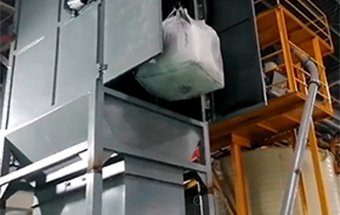 Big Bag Feeding System
The big bag feeding system can feed materials from small bags and big bags, and can convey powdered, granular materials, and lightweight vitrified microspheres.
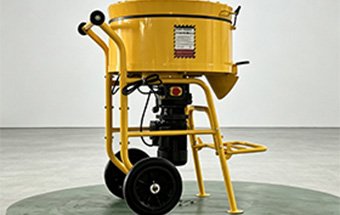 Dry Mortar Mixer
We Can Offer Paddle Mixer, Pear-Blade Mixer, Screw-Belt Mixer, Vertical-Shaft Planetary Mixer, Inclined Mixer.
How to Choose the Right Production Capacity for a Dry Mix Mortar Batching Plant?
- 5–10 metric tons per hour: Suitable for startups and small local building materials distributors. With a low investment threshold and small footprint, this line can meet the production needs for mass-market products such as basic masonry mortar and standard joint compound.
- 10–20 metric tons per hour: Suitable for construction projects serving local and neighboring cities. This production capacity covers a wide range of products, including standard tile adhesive, wall joint compound, and plastering mortar, offering the best value for money.
- 20–40 TPH: Suitable for established manufacturers with a diversified product portfolio, capable of simultaneously producing multiple high-value-added products such as tile adhesives, specialty putty, and self-leveling compounds. With ample production capacity, it can handle large-volume engineering orders and meet significant supply demands.
- 40–60 TPH: Designed specifically for medium- to large-scale manufacturers, these systems are equipped with highly automated control systems to enable 24-hour continuous production. They offer lower unit production costs.
- 60 TPH and above: Suitable for large-scale industrial production facilities. Customizable multi-tower parallel configurations enable full-range, large-scale mass production, providing exceptional market supply capacity and risk resilience.
What products can a dry mix mortar production line produce?
Modern dry mix mortar plants can produce a variety of building materials using the same production line.
- Basic General-Purpose Products:
Masonry mortar: Used for brick and block structures; high market demand.
Plastering mortar: Used for smoothing and leveling walls; wide range of applications; stable shipment volumes.
Standard wall putty: Widely used for wall decoration and surface finishing.
- High-Value-Added Products
Tile adhesive: One of the fastest-growing and most profitable dry mix mortar products.
Self-leveling mortar: A high-performance flooring material with steadily growing market demand.
Functional mortars: Including flexible exterior wall putty and thermal insulation bonding mortar, among others; these are tailored for specific construction scenarios and offer higher pricing potential.
What equipment is included in a dry mix mortar production line?
A complete dry mix mortar production line consists of multiple integrated systems that work together.
Raw Material Storage System: Used to store cement, sand, fillers, and additives. Sealed storage prevents raw materials from absorbing moisture or becoming contaminated, which is essential for ensuring the quality of the finished product.
Conveying System: Responsible for efficiently transporting raw materials between various process stages, it includes various forms such as screw conveyors and bucket elevators. A sealed conveying structure reduces material loss while minimizing dust emissions.
Batching System: One of the core components, it ensures accurate ingredient weighing and precise formula control, guaranteeing consistent batch formulations.
Mixing System: Primarily utilizes forced-action twin-shaft mixers to produce uniform mortar products, ensuring stable product quality.
Packaging System: This system includes valve bag packaging, open-mouth bag packaging, ton-bag packaging, and bulk discharge, among other options, and can be flexibly configured to suit your shipping requirements. Automated packaging significantly reduces labor costs and improves packaging efficiency.
Dust Collection System: Equipped with pulse-jet dust collectors, this system meets environmental emission standards, maintains a clean workshop environment, and minimizes raw material waste.